
DNA Series (Part 3) – 325KAMRA
Featuring Katherine Kim and Jayme Hansen
Continuing our conversation on DNA testing as a resource to connect with birth relatives, IAMAdoptee recently spoke with Katherine Kim and Jayme Hansen, co-founder and CFO, respectively, of 325KAMRA.
The mission of this organization is to DNA-test birth searching families in Korea and collect medical and family history data from them; to distribute DNA kits to Koreans and Korean adoptees worldwide, and to help families reunite when possible.
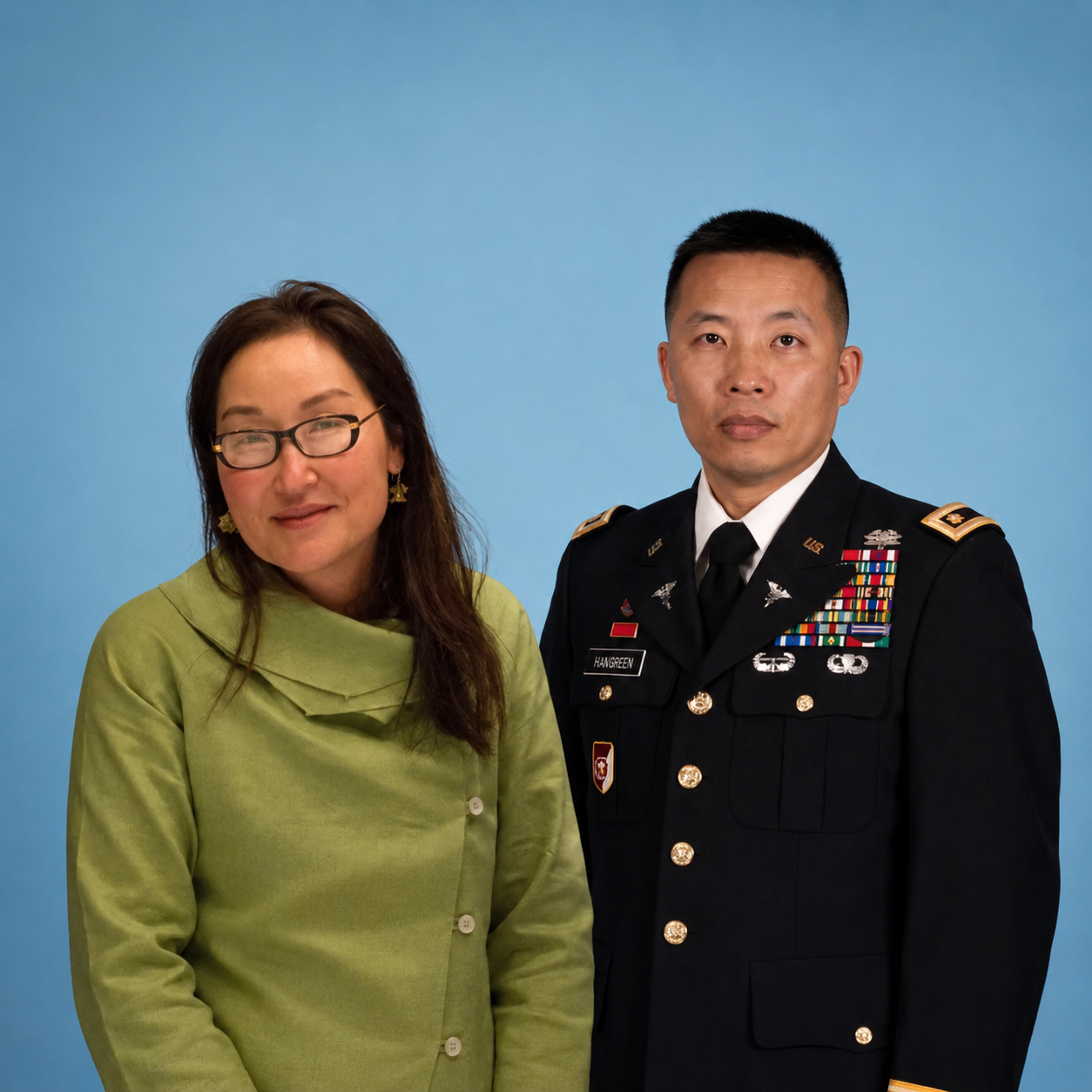
Our Conversation with Katherine Kim and Jayme Hansen
You can learn more about 325KAMRA by visiting their website at 325kamra.org.
How do you identify yourself?
KK: A mixed-race Korean adoptee, first wave
JH: KAD (Korean Adoptee), Army Officer, Husband, Father, Kitty lover
Where were you adopted from and when? And if you want to share any aspects of your life before adoption or anything having to do with that part of your life.
KK: I was born in Bupyeong-dong, Incheon in 1957 and lived with my birth mother till I was just over two years old. She (my birthmother) gave me to a GI for adoption; his application was denied so I remained in an orphanage till 3.5 years old.
JH: I was born in Chung-ju, it lies about 1.5hrs south of Seoul. It’s a small city that’s known for its cherry blossoms and a narrow stretch of road that’s flanked on both sides by gorgeous symmetrical towering trees.
Where did you grow up and where do you live now?
KK: I first lived in Southern California but in (the) third grade we moved to Washington, soon thereafter Georgia, then Texas and finally Missouri. I spent most of my adolescent years in St. Louis.
JH: I grew up on a tiny dairy farm that was nestled in North Central Minnesota. The closest village was Battle Lake and it had 1 stop light, it was 12 miles away from where we lived. I grew up in this rural community until I joined the Army when I was 17 years old. I currently reside in Ramstein, Germany, where all the wounded from the Middle East are evacuated to.
What is your profession?
KK: I had been a teacher and worked as a technical editor in my early work life. For a long-time, I was a stay-at-home mom. Today, I am the president and co-founder of 325Kamra, working with Korean adoptees and Korean hapas (a person is who is partially of Asian or Pacific Islander descent) on finding their biological family thru the use of DNA.
JH: I am a Lieutenant Colonel in the United States Army and I am the Chief Financial Officer (CFO) of a Medical Center and 5 surrounding clinics that service Europe. I have worn numerous hats during my 30-year career with the military: cook, combat medic, information operator, nurse and hospital administrator. I have also 27 years of NGO/NPO/Volunteer work. Today, I am the CFO and director of European Operations for 325Kamra, I assist with the strategic planning and have traveled to 40 locations/12 countries to meet up and test more than 1,200 adoptees throughout Europe in the last 3 years.
What is the origin story of 325KAMRA?
KK: In September 2015 there was a Koreans and Camptowns conference in Berkeley, CA. Many of the attendees there were mixed race adoptees, like myself, and another co-founder, Bella Siegel Dalton, was one of the speakers there who talked about using DNA to find her father’s family.
I personally had done DNA testing in 2011 with no close matches, and many in the KAD community were doing the same. (This was made possible) in part to the gift program of free (DNA) kits that Thomas Park Clement established in late 2015.
During the conference many of us talked about using autosomal DNA tests in Korea and trying to get bio family there to come forward and test. We knew if we could do this that many would find more family.
The name 325 is the number of the hotel room that we founders shared that conference weekend…and Kamra is an acronym for Korean American Mixed Race Adoptee.
How did you get involved and what is driving your passion for this organization?
KK: Seeing the successes of DNA matches, we knew that DNA could lead us to bio family either through automatic matches or through reasonably close matches (second cousins or higher). I believe everyone deserves to know their heritage, and medical history, and when we contact bio family this is what we ask for.
JH: When I moved to Europe, I began searching for KAD organizations to belong to and I noticed that there were thousands of KADS living in Europe. I heard about the work of 325KAMRA and I approached them about servicing the 50,000 KADS that resided here. What’s driving my passion was the heartfelt stories from the Adoptee community and their search to find family. I was lucky enough to find my biological father and it helped me to have peace with what happened. I wanted to be a part of a team that was trying to change lives and give real hope in reuniting with their families.
How would you like Korean adoptees to consider DNA testing and submitting their biological data?
KK: Our mantra is to test everywhere: FTDNA, ancestry, 23andme, to upload DNA to all the free sites (Genesis Gedmatch, MyHeritage, etc.). We are also suggesting leaving your DNA with the police in Korea, and for adoptees to monitor their DNA accounts on a regular basis.
What are the recent statistics for 325KAMRA and its ability to connect adoptees with primary (parents and siblings) birth family relatives?
KK: As of today, we have connected 87 people with bio family thru DNA and the tools of genetic genealogy (researching archived records, state records, obits, newspaper articles, etc.). We have at least 4 other cases that are close to confirmation. As far as automatic matches for KADs there have been well over 200 automatic matches with people finding parents, siblings (half and full) and close cousins.
DNA testing and your adoption story is intricately linked. What would you like to share about this part of your search journey?
What would you like your fellow Chinese adoptees to know about DNA testing and submitting their biological data?
DNA testing has its pros and cons. While some people (and adoptees) aren’t comfortable with using DNA tests, I also understand how using them may feel necessary as there are very few, if any, alternatives. However, I would caution Chinese adoptees who are interested in doing DNA testing to be aware of the Chinese laws regarding DNA testing. It is illegal for people to remove any bodily fluids, which includes DNA, from the country; in other words, if someone is trying to collect DNA from Chinese first families within China but test them in the United States, it is illegal. While I understand the concerns some may have about the validity of tests within China versus outside of it, I would not want to take a chance with this as DNA testing is still relatively new. Additionally, I fear that if individuals or organizations continue to transport DNA tests outside of China, it could negatively impact the searches for others in the future, especially as DNA testing for the purpose of searching is becoming more popular. Please see this document, which was created by an adoptive parent active in Chinese birth searches, with more information about the specific Chinese laws regarding the removal of DNA from China.
What would be a good few steps about searching in China that you would like adoptees to know?
From my personal experience, the process of searching has been incredibly difficult, emotionally draining, and at times quite demoralizing. I’m proficient enough in Chinese to be able to use Chinese social media in order to spread information, but the interactions I’ve had with people through these platforms have been mixed. I have gotten many messages from people wishing me the best and offering to help; however, I’ve also gotten messages from people who question why I’m searching and who claim that I am not being filial/loyal to my adoptive parents. I understand where these sentiments come from, and have come to expect them at this point, but they still hurt. I don’t say this to discourage Chinese adoptees from using these platforms in their search–in fact, if you can use them, do it–but instead as a warning and to urge you to be as prepared as you can for such moments. I think it is helpful if you have an adoptee friend that you are comfortable with to talk to about the search, and who can help you process what is happening, because there is so much emotional labor on your part that goes into it.
If a Korean adoptee wants to connect with 325KAMRA as a resource in their search, what are the steps you recommend?
KK: First, make sure they have DNA tested everywhere. If they have a match of 200 centimorgans or higher, they should contact us, become a member and then we will help them. If they have a match to kit we have collected from Korea, we will also help them establish contact (with membership).
JH: Yes, DNA test with the big 3 testing agencies: 23&me, Ancestry and FTDNA. Obtain your records and check to see if anyone inquired for you – do it in person by visiting the agency in Korea. Be patient and learn from the success of others. Like me, some have gone on National TV shows such as KBS. Others have hired detectives.
How much does this service cost?
KK: An annual membership is $50 USD; A lifetime membership is $300 USD.
JH: The tests themselves are free of charge to anyone who identifies as Korean. Specifically however, we provide services to Korean Adoptees, Korean HAPAs, US Service members who believe they may have Korean children and Korean families in search of children they may have relinquished. The annual memberships open the door for additional services. Shipment of test kits to overseas locations maybe subject to administrative fees that cover shipping, maintaining a website, and other administrative costs.
What happens to the DNA data?
KK: This depends on the company. You would have to read each individual site (Ancestry, FTDNA, 23andme) to make that determination.
JH: Katherine is absolutely correct; this depends on the company. Most DNA testing companies have strict guidelines, controls, and operate under tight physical security. All companies have a processing center where the personal information is separated from the actual DNA sample and tested in a separate facility. The DNA sample itself is often identified by a small barcode or inter-company specific code/number to prevent workers from identifying those that submitted their test samples.
Who owns it (DNA material)?
KK: The tester owns the DNA. For those who test in Korea and who want us to manage their kits, then we manage those.
JH: First, an individual’s DNA is placed everywhere. When a person eats a partially eaten sandwich, touch a door knob, or brushes their hair off their coat collar…they leave trace amounts of DNA virtually everywhere. The DNA is unique to each individual and it belongs to them. This is why DNA testing companies must ask individuals for their consent before they are tested. Most DNA testing companies with place safeguards to help individuals to remain anonymous and to anonymized specimens. As for true ownership, legally, nobody can own or have ownership of DNA information. Companies initially requested patents on snippets of DNA after the onset of CRISPR but it was later made illegal to have ownership of any piece of the human body to include the DNA. The tests themselves will degrade overtime and it is a standard practice for many DNA testing facilities to destroy samples after 25 years. It also costs a lot of money to house and store the samples for the long term. Specialized freezers that reach -80 degrees or liquid nitrogen is used to prevent degradation of the DNA samples. Most testing companies will allow individuals to withdraw/destroy their samples at any time for a nominal fee.
What happens if a match is made?
KK: If a match is made thru FTDNA, the kit that is free to KADs, we get notification of the match. Sometimes a KAD may be aware of this (if they have put in their email for registration on the FTDNA website – not all do though). When we are notified, we in turn notify the KADs. Some KADs get notice on other sites and then approach Bella or myself…Some just contact their closest match directly.
JH: The notification as Katherine described is correct. However, each individual reacts differently to the news when they are contacted. Some adoptees ask to keep their reunion private to meeting individuals that are in jubilee and willing to share their stories with the media and public.
What words of encouragement do you have for fellow adoptees and DNA testing?
KK: For those interested in birth searching, DNA is a total game changer. It cuts through the fiction that many of us have. But it does require patience. People get discouraged when they find themselves without close matches. I first tested in 2011 and didn’t have my first close match till October 2015. I then did a records research on my Korean mother, found a potential candidate, and got her daughter to DNA test. This was 2019. So from 2011 to 2019….that’s eight years of waiting and searching. This is a long game and people have to go into it knowing that…But DNA is a tool that works, especially when all other methods fail. Some lucky ones have instant automatic matches….but most don’t. So people need to test everywhere, and keep faith and be patient.
JH:
Be realistic: Most individuals do not understand the science of DNA and may have unrealistic expectations of what it can or can’t do. Each company has their own algorithms on measuring the percentage of ethnicity and a variance can be seen between the companies. Some companies have a larger catalog of regional haploid groups and be more accurate.
Be patient: Companies run specials all the time. It may take an additional 2-4 weeks for the DNA sample to process through the system. Individuals may become worried that the samples have become lost and we have to give individuals encouragement to remain calm.
Read up: Each individual has a unique genetic marker that is different as each snowflake or fingerprint. New research has shown that identical twins share many of the genes but identical they are not. This is why crime and paternity DNA tests cannot be refuted.
Have hope: When I first joined the organization 3 years ago our success rates were around 1:230 people yielded into a familial match and today it is closer to 1:65. Katherine, Bella and some of our volunteers have access to other powerful search tools and become proficient with the use of these tools.
What words of caution do you have for our community?
KK: If they DNA test, that they must be patient and test everywhere per the aforementioned recommendations. Manage their expectations if they do find bio family…every outcome is different and you have to be prepared for the worst, just in case.
JH: Each one of our journeys are different. I see many adoptees become divisive and defensive. We cannot make our community better if we remain that way. I am in awe by this small group of adoptees that united together to form 325KAMRA and make a difference in the lives of so many adoptees.
I love what Katherine said about managing expectations. I have seen adoptees get rejected again (by birth relatives) to the sobbing heartfelt reunions many imagine. I was very lucky to witness the reunion of 3 siblings. One resided in the United States and the other 2 siblings lived in Europe within a 100-mile radius of each other. You may find a sibling instead of a parent.
What is the conversation that you want to be having in adoption that you are not hearing?
KK: Adoption is such a controversial topic in our community…with those who are pro- or anti-, etc. I can’t say that there are topics I am not hearing about, but the area that I think needs to remain spotlighted is the one pertaining to citizenship for ALL adoptees. I think that conversation needs to stay at the forefront!
JH: Mental Health/Suicides/Resilience: The United States Military spent $117M on how to increase psychological resilience. The adoptee community needs to speak up and use these techniques to save lives. My heart is distraught to learn about another adoptee death. We can’t accept these deaths and we need to band together and save lives.
Deported adoptees/adoptees in crisis: I know some heroes out in our community that are working behind the scenes to provide support and assistance to the most vulnerable within our community. So many adoptees are in need and sometimes they don’t have the maturity and executive skills to take care of themselves. I have a sister that did not live up to her potential and I have had to come in several times to assist her and we cannot be apathetic or hate people for not being as capable or for having issues.
I have to echo Katherine again! We need to fix the loopholes in the Child Citizen Act of 2000 that left (estimated) 64,000 adoptees without citizenship.
What do you wish people would know about adoption that gets little air time?
KK: This is hard to answer….air time in the adoptee community or air time in the public at large? Within the adoptee community, I feel like a lot gets aired but for the public at large, they need to be reminded that adoptees always have two families, whether they are recognized or not….and that adoption is complex. So many still push their gratitude attitude on many of us, and that to me is offensive. While I personally am very grateful for my adoption, I dislike when I read comments from others how birth searching or this or that is a betrayal to our adoptive families. In truth, I think even among adoptees that the notion of betrayal to adoptive families remains strong and there might be more discourse on this…helping KADs process these types of feelings….
JH: Katherine nailed it on this one too… when an adoptee searches it’s not about you. It’s something for them. Some of us need closure. Some of us need to try. Some of us need to experience our culture and see our motherland. Some of us want to know our medical history… whatever reason we have to go on this journey…it’s for our own healing, learning, and growth. Families that reject, demand that they don’t go forward or disown them because they feel they were somehow rejected only add more pain to an already injured soul. I have heard so many adoptees tell me this… it breaks my heart every time.
Adoptee to Adoptee: What is the best part of being an adoptee?
KK: Having opportunity that I would never have had otherwise.
JH: The adoptee community. “I’m adopted”…with one phrase we can know so much about each other. We can be a loving, caring, crazy, off the chain bunch! I’ve learned so much from other adoptees and I am a better person because of it.
What is the hardest?
KK: I think being relinquished for adoption is a source of hurt. Being a mixed-race Korean adoptee, it was very evident that I was adopted so it always came with an onslaught of private questions from perfect strangers…this was hard for me to talk about it, but I got better at it growing up, but I think this was still the hardest part for me.
JH: I remember older TV’s would have a condition called “burn-in images” and these images were also known as “ghost images”. I think many adoptees have these ghost images burned into them – often a negativity or fear that’s retained from our childhood. It maybe fear of abandonment, fear of relationships, or in my case – a constant fear that I am never good enough. This fear came from the abuse, name calling, and neglect shown by my adoptive parents and the constant bullying from kids at school.
Is there something you have incorporated into your daily life that is specifically Korean?
KK: I jones for Korean food at least 2x per week. And Korean masks, yah, gotta have my Korean beauty products! Lol
JH: Korean food is now a requirement, my kids love watching Korean Dramas, and I love Ginseng Tea – I drink a cup before I go to bed almost every night.
Finish this sentence: “Next time I go to Korea…”
KK: Next time I go to Korea, I hope to meet my half uncle and that side of the family.
JH: Next time I go to Korea, I will gain 10 lbs! I can’t wait to meet my adoptee friends that work and reside in Korea!
